
I’m sure most internet users have at least once experienced lying in bed feeling worse than you’ve ever felt in your life. Fever running high, coughing, sneezing, your body producing more snot and mucus than you thought humanly possible. In desperation, you reach over to your trusty mobile and start googling your symptoms, only to have Dr Google exacerbate your anxiety and convince you that ‘this is it’.
After some much needed rest, most will shake off our foolhardy flu fog and swear to never call Doctor Google again. However, similar to Hypochondria, some people become so obsessed with googling their symptoms that they develop a serious disorder dubbed Cyberchondria or Google-itis (Thompson 2014 p. 292).
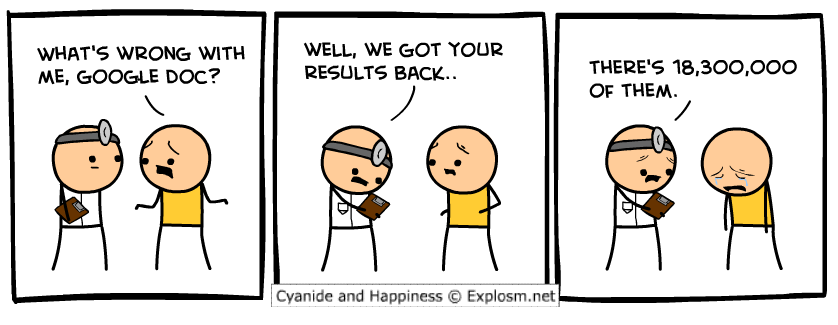
Health information searches are the third most common use of the internet, after social media and email, with approximately 83% of all internet users searching for health-related information online (McCosker 2016).
Internet searches can be problematic due to the amount of misinformation posted online from unqualified and non-credible sources. Health Direct is a government funded service providing credible and professionally approved advice. The service also includes an online symptom checker which can help to assess and advise on what health care steps you should take, whether that be self-care at home or the need to attend a doctor or hospital (HealthDirect.Org 2018).
A research study conducted by Surrey University on women seeking information online regarding breast cancer symptoms, found that many felt overwhelmed by the amount of information online and it’s reliability. Most chose to seek further advice from their general practitioner (ScienceDaily 2018).
Organisations such as Cancer Australia and the Breast Cancer Awareness Network, provide access to credible research and helpful online information to raise awareness and encourage self-examination for early detection.
In addition to the Cancer Council’s important fundraising activities through the pink ribbon initiative, the Breast Cancer Awareness Network provides downloadable resources, a support helpline, online ‘my journey’ tool, online peer support network and a new fortnightly podcast series called Upfront.
They also effectively utilise social media for their campaigns. Their Twitter page promotes initiatives and regularly posts the latest studies, while Facebook is the perfect platform for sharing stories and providing a support network. The organisation’s YouTube channel provides informative videos, interviews with survivors and exercise videos to strengthen recovery.
In the journal article, Living with Cancer – Affective Labour, Self-expression And The Utility of Blogs, Anthony McCosker & Raya Darcy (2013) imply that social networks can provide great value and empowerment to people with chronic and terminal illnesses, such as cancer, offering platforms to write about how they’re feeling and what they’re suffering, share information, connect with others for emotional support and be actively involved in their own self-care and emotional management.
In 2014, Cancer Council NSW engaged the creative services of the J. Walter Thomson agency to create the beautiful and powerful #itouchmyselfproject. Inspired by Australia’s own rock goddess Chrissy Amphlett (The Divinyls), who sadly lost her battle with breast cancer in 2013.
The campaign used the Divinyls hit I touch myself as an anthem to highlight the importance of early detection through self-examination (J. Walter Thomson 2014). For this project, fellow Australian singers Sarah McLeod, Deborah Conway, Connie Mitchell, Little Pattie, Sarah Blasko, Olivia Newton-John, Kate Ceberano, Suze DeMarchi, Megan Washington, and Katie Noonan recorded versions of the hit to encourage women to be in touch with their bodies and see a doctor if something doesn’t feel right (itouchmyself.org 2014).
In 2018, the campaign was re-recorded with tennis great Serena Williams, reaching over 1 billion people.
This health campaign resonates strongly with me, not just as a woman, but also in having lost a dear friend to this dreadful disease. 1 in 8 women are diagnosed with breast cancer, but it can be beaten if detected early.
October is Breast Cancer Awareness month, get involved to show your support for families impacted, and encourage the women in your life to get in touch with their breasts.
References :
I Touch Myself.Org, 2014, < https://www.youtube.com/watch?v=FeaO2BrrIf8>.
J. Walter Thomson, 2014, I Touch Myself/NSW Cancer Council, < https://www.jwt.com/en/work/i-touch-myself-nsw-cancer-council>.
McCosker, A 2016 ‘Digital Mental Health and Visibility: Tagging Depression’, in P. Messaris and L. Humphreys, Digital Media: Transformations in Human Communication (2nd edn), Peter Lang, pp 1-11.
McCosker, A & Darcy, R 2013 ‘Living With Cancer: Affective Labour, Self-Expression and the Utility of Blogs”, Information, Communication & Society 16(8), 1266-85.
ScienceDaily, 2018, How much do you trust Dr. Google? <https://www.sciencedaily.com/releases/2018/11/181128115003.htm>.
Thompson, TL 2014, Encyclopedia of Health Communication, SAGE Publications, Inc, Thousand Oaks, CA, viewed 20 September 2019, <http://search.ebscohost.com.ezproxy.lib.swin.edu.au/login.aspx?direct=true&db=nlebk&AN=800417&site=ehost-live&scope=site>.
Images:
Breast Cancer Candles [Image], 2017, in Pixabay, Dickason, G <https://pixabay.com/photos/breast-cancer-candle-dragonboat-2732757/>.
Google Doc Cartoon [Image], 2015, in Explosm.Net, <http://explosm.net/comics/3935/ >.
#ITouchMyself Case Study [Video], 2014, <https://www.youtube.com/watch?v=IuE9BdO9eoY>.
#ITouchMyself2018 Case Study [Video], 2018, <https://www.youtube.com/watch?v=pvl_L1qPqlQ&has_verified=1 >.
Pink Ribbons [image], 2018, in Marie Clare, <https://www.marieclaire.com.au/pink-products-2018 >.
 Rebecca Fairley