
This week’s post is all about trolls. No, not the nasty ugly monsters we read about in fairy tales, but the new breed that are the bane of social media.
Troll: “a person who intentionally antagonizes others online by posting inflammatory, irrelevant, or offensive comments or other disruptive content”
Trolling: “to harass, criticize, or antagonize (someone) especially by provocatively disparaging or mocking public statements, postings, or acts” (Merriam-Webster 2019).
Trolling is somewhat similar to Cyberbullying, however, cyberbullies usually attack people they know, while trolls often don’t know the groups or individuals they’re harassing. Its malicious behaviour aimed at creating conflict for the troll’s amusement (Howard et al 2019 p. 309).
Hootsuite (2019) advise of 5 signs you’re dealing with a troll:
1. They want to make you angry
2. They are attention seeking, and act entitled
3. They exaggerate with the aim to inflame
4. They go low and make it personal
5. Spelling and grammar are not a priority
Once lurking in dark crevices of the internet, trolls and trolling are now mainstream everyday occurrences with some trolls no longer even caring about anonymity (Hannan 2018).
In his journal article ‘Trolling ourselves to death? Social media and post-truth politics’ Jason Hannon (2018) states that “If Facebook is a high school popularity contest, then Twitter is a schoolyard run by bullies. It is the medium in which both Milo and Trump honed their craft as trolls”.
This begs the question, of how can we possibly hope to rid the internet of trolls when by definition and repeatedly demonstrated tweeting behaviour, the Troll in Chief (aka POTUS) sits in the White House?
A study found that due to higher levels of narcissism, men were more likely to partake in trolling than women (Ferenczi 2017) and according to research conducted by Demos, women in media and journalism are subjected to three times as much online abuse as men in the same industry (Tapper 2014).
Disturbingly, a ‘boys club’ of French journalists are facing accusations of trolling and harassing female journalists via social media through vile memes, doctored images and condescending tweets (Willsher 2019).
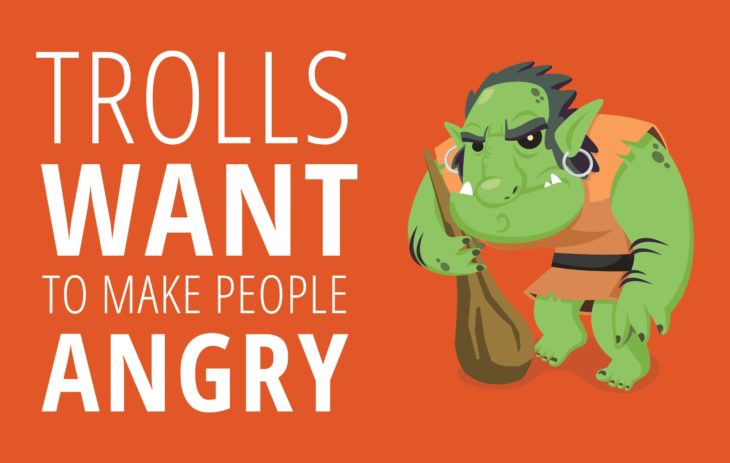
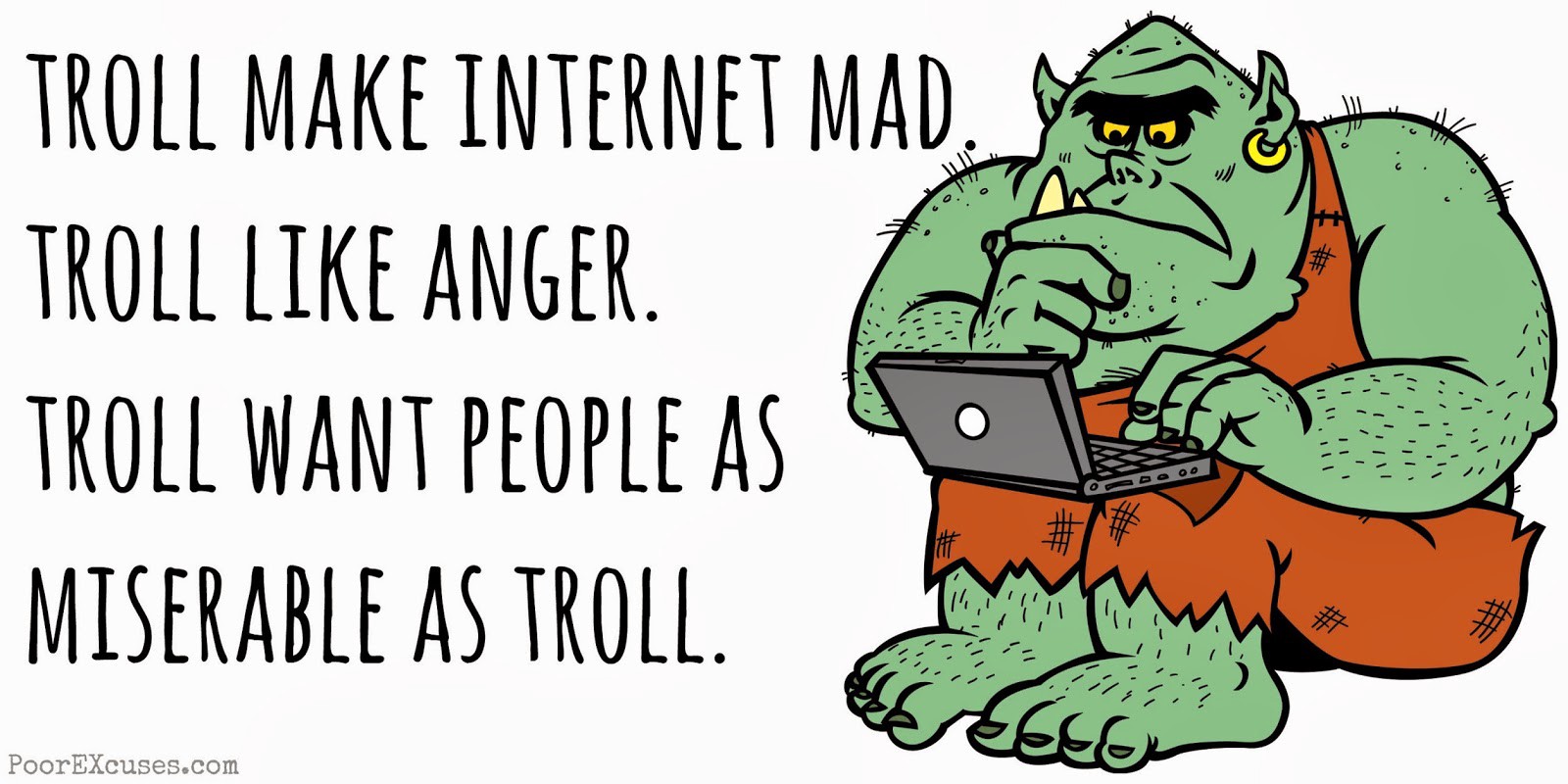
The old adage Don’t Feed The Trolls is constantly drilled into social media users. There is some validity in this adage, as responding can fuel the troll’s ego and keep them going, while, theoretically, ignore them and they’ll get bored and leave.
However some trolls are more extreme, abusive and violent than others and it can be irresponsible to ignore them. Speakers at a conference on online abuse, said that the link between online abuse of women and domestic violence should not be ignored. Polly Neate CEO of Women’s Aid further stated that “It is critical that we make the link between this vicious online harassment and cyberbullying and real-life violence against women” (Topping 2013). This kind of trolling is not harmless and it’s not a joke.
Australian journalist and author, Clementine Ford has been dealing with aggressive and abusive trolls for years. She’s regularly received threats of death, rape and other violence. In a recent article, Clementine discussed why she chose to take her worst trolls public and how that action enabled one of the named and shamed trolls to converse with people around him and gain an understanding of why his behaviour was so wrong (Ford 2019).
There’s only so much users can do to stand up to and report this sort of behaviour. Social networks such as Facebook and Twitter, need to stop allowing people to get away with it. People do need to be held accountable for their actions.
Hootsuite produced a guide called ‘9 tips for handling trolls on social media’, while its aimed at helping business protect their online persona, it provides great advice for all social media users.
Like the brave knight in this post’s cover picture, some days I yearn to prod the trolls back with my spear of knowledge (laced with a little touch of smart-arsery) aiming to educate and enlighten.
But alas, on most occasions if the trolling is just ignorance and absurdity (with no violent overtones), I summon up all my willpower to just deeply sigh, shake my head, and step away from the computer, all while ear worming myself with ‘let it go, let it go’.

References:
Clarke, T. 2019, ‘Social Media Trolls: A Practical Guide for Dealing with Impossible People’, Hootsuite, viewed 30 August 2019, <https://blog.hootsuite.com/how-to-deal-with-trolls-on-social-media/>.
Ford, C. 2019, ‘Clementine Ford: There’s A Reason I Take My Vilest Troll Attacks Public’, 10 Daily, June 2019, viewed 20 August 2019, <https://10daily.com.au/views/a190606eaklj/clementine-ford-theres-a-reason-i-take-my-vilest-troll-attacks-public-20190606>.
Ferenczi, N, Marshall, T & Bejanyan, K., 2017, ‘Are sex differences in antisocial and prosocial Facebook use explained by narcissism and relational self-construal?’, Computers in Human Behavior, Volume 77, December 2017, Pages 25-31, <https://doi.org/10.1016/j.chb.2017.08.033>.
Hannan, J. 2018, ‘Trolling ourselves to death? Social media and post-truth politics’, European Journal of Communication, 33(2), pp. 214–226. doi: 10.1177/0267323118760323.
Howard, K, Haskard Zolnierek, K, Critz, K, Dailey, S & Ceballos, N. 2019, ‘An examination of psychosocial factors associated with malicious online trolling behaviours’, Personality and Individual Differences, ISSN: 0191-8869, Vol: 149, Page: 309-314, viewed 30 August 2019, <https://www-sciencedirect-com.ezproxy.lib.swin.edu.au/science/article/pii/S0191886919304003?via%3Dihub>.
Tapper, J. 2014, Demos: ‘Male celebrities receive more abuse on Twitter than women’ Demos, 24 August 2014, viewed 30 August 2019, <https://demos.co.uk/press-release/demos-male-celebrities-receive-more-abuse-on-twitter-than-women-2/>.
Topping, A. 2013, ‘Online trolling of women is linked to domestic violence, say campaigners’, The Guardian, September 2013, viewed 31 August 2019, <https://www.theguardian.com/society/2013/sep/03/online-trolling-women-domestic-violence>.
Trolling 2019, Merriam-Webster.com, <https://www.merriam-webster.com/dictionary/trolling>.
Willsher, K. 2019, ‘French ‘boys’ club’ of journalists accused of bullying women online’, The Guardian, 12 February 2019, viewed 30 August 2019, <https://www.theguardian.com/world/2019/feb/11/french-boys-club-of-journalists-accused-of-bullying-women-online>.
Images:
Knight & Troll [Image], in Pixabay, Peter Fischer 2018, viewed 31 August 2019, https://pixabay.com/photos/knight-troll-fantasy-held-monster-3376073/>.
Let it go Giph [image], in giphy.com, <https://media.giphy.com/media/igR5863TALcSk/giphy.gif>.
Troll meme 1 [image] <https://www.searchinfluence.com/blog/dont-feed-the-trolls-a-crash-course-in-dealing-with-twitter-trolls/>.
Troll meme 2 [image] <https://artplusmarketing.com/i-don-t-suffer-trolls-6a5b733e2e77>.
 Rebecca Fairley

Absolutely agree with you 100% Bec, people do need to be held accountable for their actions and to do nothing will be exactly what the trolls want. You get so sick and tired of the ‘Keyboard warrior’s that hide behind their keyboards going out thier way to provoke with malicious comments in order to hurt the receiver. It is such a complex issue in which I feel needs more attention around to create awareness and empowerment of those dealing with such bullies.
Great Work
Toni
LikeLike